
Date: Jun 30, 2026 · by: Susan Kraft-Yorke
Overview
Legacy finance systems classify technical writing as overhead because they were designed to measure tangible assets like machines and inventory rather than internal knowledge work. This outdated model creates a significant valuation gap for modern companies, where product, API, and compliance knowledge carry daily operational value. Because businesses track writing as a cost center rather than an asset, information workflows suffer from weak ownership, poor metadata, and fractured lifecycles, despite creating real value across customer adoption and engineering continuity.
Modern information architecture directly bridges this valuation gap by treating knowledge as a strategic asset. This structured optimization ensures that file repositories are prepared for both human teams and advanced AI systems.
Obsolete model: technical writers as overhead
A cost center tells leadership what a function spends. It does not show how much operating leverage that function creates across the company. That distinction matters in technical publications because the writing expense is visible in payroll, while the operational value is dispersed across engineering, support, customer onboarding, implementation, compliance, release readiness, and institutional continuity.
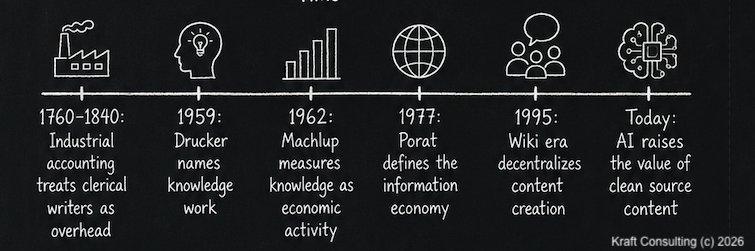
Figure 1: Timeline of accounting categories of business information sectors from the dawn of the industrial revolution through the information and AI revolution.
In older accounting models, this made technical writing easy to place under overhead. The company could see the labor cost. It had a weaker way to see the compounding value of well-governed technical knowledge. That classification became familiar, but familiarity is not the same as accuracy.
A technical publications group does more than produce documents. It creates reusable operating knowledge. That knowledge reduces support load, improves customer adoption, protects implementation quality, preserves release context, and gives new employees a path into complex systems. ...
(Contact us to continue reading.)
Property of Kraft Consulting ©2026 