
By Susan Kraft-Yorke · July, 2026
Overview
Enterprise retrieval-augmented generation, or RAG, is commonly framed as a technical architecture for connecting LLMs to internal knowledge repositories. This framing emphasizes retrieval pipelines, embeddings, chunking, and response generation. These conditions affect the trustworthiness of AI-generated answers.
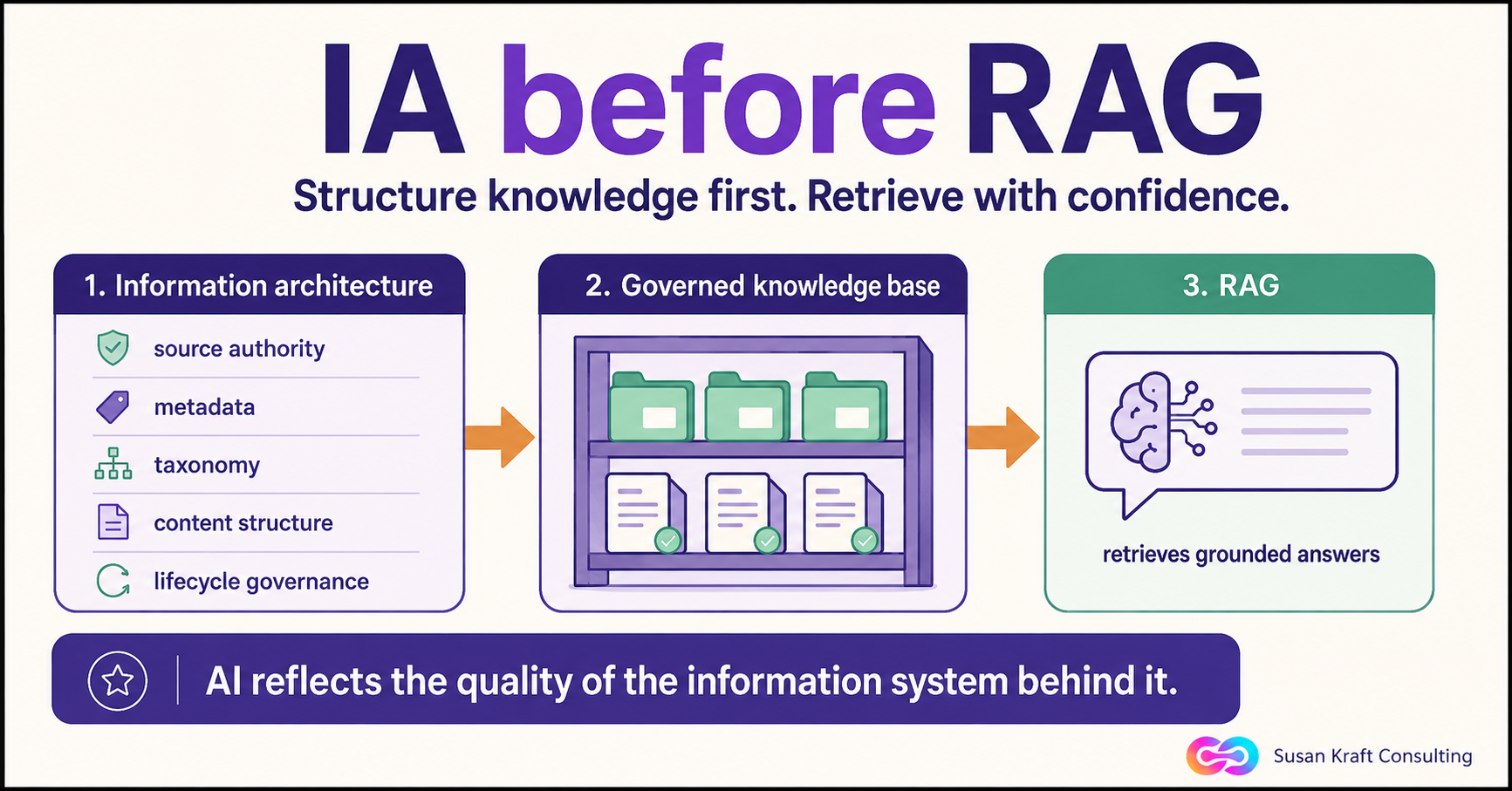
The central contribution of this discussion is a strategic operating model: information architecture (IA) establishes the governed knowledge system, while RAG provides an AI-enabled access layer to that system. This model shifts enterprise AI readiness away from tool deployment alone and toward the design, maintenance, and governance of trusted information assets.
Prerequisites
The prerequisite for enterprise content to loop in AI retrieval systems, like RAG, a trained HITL must first:
- define authoritative sources
- normalize metadata
- structure documents for retrieval
- assign ownership
- govern review cycles
- remove obsolete content
Introduction
A stronger business protocol starts with IA prior to using RAG first. That way, when RAG connects an AI system to your company knowledge, it retrieves relevant and verified sources to generate grounded solutions.
IA defines a tailored workflow to determine how enterprise knowledge is findable, current, governed, structured, and trustworthy. RAG depends on that system being in place and trustworthy.
It is my contention that high RAG quality depends on IA defined metadata, taxonomy, document structure, lifecycle governance, version control, and content ownership.
A real AI-related fear recently shown in the literature and conversations is how AI amplifies files that should never have been in the AI workflow. They should have been pre-sorted and a documentation management structure validated and managed with an evergreen system for future information asset health.
Plan to take time to plan and set up for clean success so you do not have to pay countless hours for imperfect cleanup after your systems are built with poorly planned designs.
An IA led strategy turns RAG from an AI feature into a governed knowledge access layer.
Problem statement
Enterprise AI programs often begin at the retrieval layer.
Many organizations start with a technical goal: connect a language model to internal information sources. Common enterprise sources include Confluence, SharePoint, Google Drive, GitHub, Jira, PDFs, SOPs, API documentation, and support tickets.
These systems are typical RAG inputs. Consider common business weaknesses:
- poor discoverability
- duplicate content
- stale documentation
- unclear ownership
- inconsistent structure
Those weaknesses shape the quality of every AI answer.
RAG retrieves from the information environment it is given. A source environment with conflicting implementation guides, outdated release notes, abandoned SOPs, duplicate API references, and unlabeled drafts gives the retrieval system weak evidence. The AI system may generate a fluent answer from material that carries limited authority or expired operational value.
The risk sits in the source chain.
The original RAG research by Lewis et al. describes retrieval augmented generation as a way to combine a pretrained language model with an external knowledge index. That architecture improves knowledge-intensive tasks because the model retrieves outside source material before generating an answer. This makes the external information system central to answer quality.
Enterprise AI succeeds when the knowledge system underneath the model supports accurate retrieval, traceability, ownership, and reuse. ...
(Contact us to continue reading.)
Property of Kraft Consulting ©2026 