
By: Susan Kraft-Yorke · Jun 30, 2026
Abstract
AI has not fixed the knowledge-worker search tax. In many firms, AI has made the problem worse by increasing content volume, duplication, scattered context, and the time workers spend checking whether information is correct.
The pre-AI baseline information search comes in at ~20% payroll leakage.
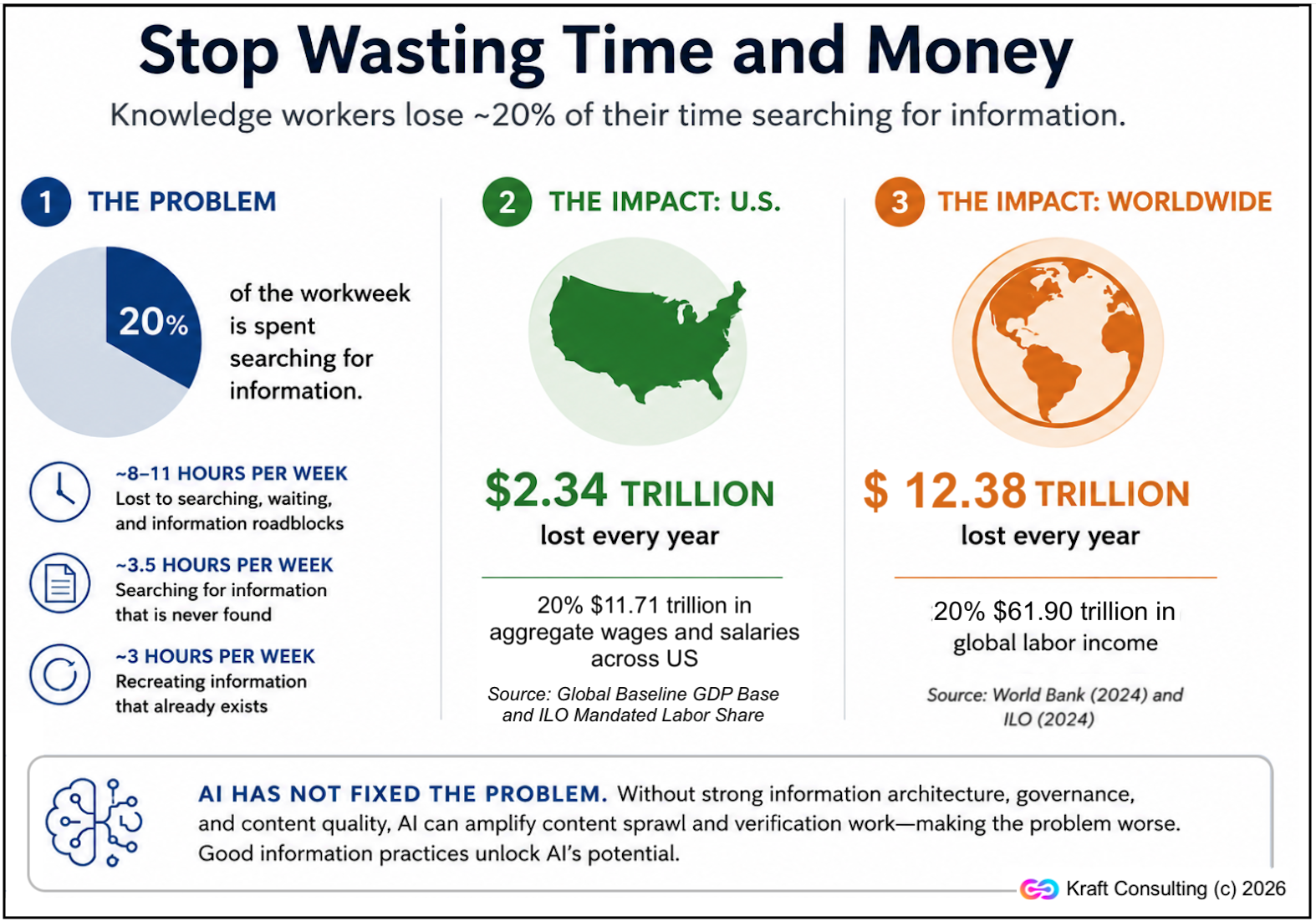
Applied to 2024 U.S. wages and salaries of $11.71 trillion, that 20% estimate equals about $2.34 trillion per year. Using 2024 world GDP and labor-income share estimates, worldwide labor income is about $61.90 trillion. A 20% search tax equals roughly $12.38 trillion per year.
AI improves retrieval only where Information Architecture, governance, metadata, source quality, and lifecycle controls already exist. Without those controls, AI accelerates the mess.
The fix starts with an AI-assisted Information Architecture migration. Audit the content. Remove duplication. Assign ownership. Add metadata. Govern the knowledge base before connecting it to corporate AI systems.
References for financial estimates
- National Income & Product Accounts, Personal Income & Outlays. (FRED: Total wages and salaries, BLS)
- U.S. Bureau of Economic Analysis, National Income and Product Accounts (total U.S. wages and salaries). (BEA National Economic Accounts)
- Indicators: World Bank World Development Indicators (global GDP). (World Bank Open Data)
- GDP current US$: National Statistical Organizations and/or Central Banks. (Global GDP: World Bank Open Data)
- Feldman, S. (2005). The Hidden Costs of Information Work. (an IDC white paper). Demonstrates that knowledge workers spend more than 27 hours per week searching for, gathering, and analyzing information, with significant time lost to unsuccessful searches and recreating missing information.
- Michael Chui, James Manyika, Jacques Bughin, Richard Dobbs, Charles Roxburgh, Hugo Sarrazin, Geoffrey Sands, and Magdalena Westergren. The Social Economy: Unlocking Value and Productivity Through Social Technologies. McKinsey Global Institute. (2012). Reports that knowledge workers spend approximately 19 to 28 percent of their workweek searching for and gathering information, establishing the widely cited productivity baseline.
- (ILOSTAT)
- A Century of Plenty. December 10, 2025. McKinsey Global Institute. This book, a major research effort from the McKinsey Global Institute, explores the advances of the past century and what drove them—what we call the progress machine
- International Labour Organization
- International Labour Organization report
Property of Kraft Consulting ©2026 